For parents
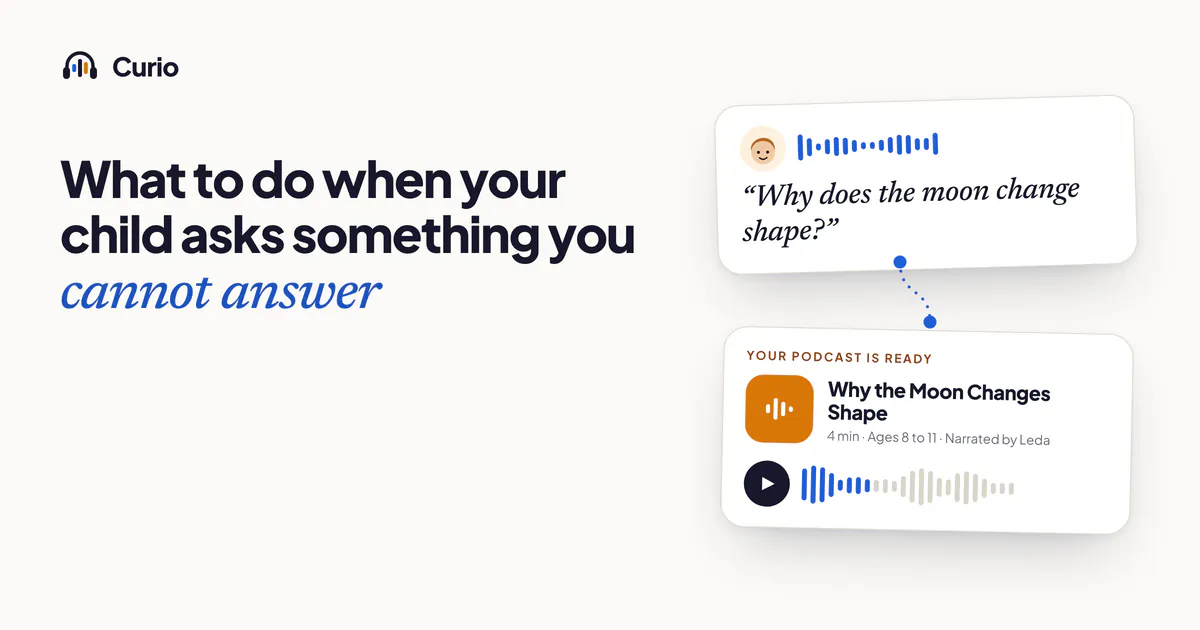
It usually happens at a bad moment. You are driving, or cooking, or tired, and a small voice asks why the moon changes shape, or where the wind goes, or how a bat finds its way in the dark. You do not know. Your first instinct may be to change the subject, make something up, or hand over a screen.
None of those is a disaster. But there is a better way to handle the question, and it takes less effort than it sounds.
Say so, and mean it
"I do not know" is a good answer when it is followed by "let's find out." Children watch how the adults around them deal with not knowing. If you show that it is normal, and even a little exciting, they learn that a question is something you can do something about.
What helps is the second half of the sentence. "I do not know" on its own can close the door. "I do not know, and I would like to find out" opens it.
Why a real answer matters
Researchers Brandy Frazier, Susan Gelman and Henry Wellman studied how preschoolers respond to different kinds of answers. They found that preschoolers were more satisfied by explanatory answers, and more likely to ask again after answers that did not explain anything. You can read a summary of the work in this ScienceDaily report.
That is one study of young children, not a rule for every child or every question. But it matches what many parents notice: "because it just is" tends to bring the same question back ten minutes later. A short, true explanation, even a simple one, tends to settle it.
Five small habits that help
- Ask what they think first. "What do you think happens to the moon?" Children often have a theory, and hearing it tells you what they are actually asking.
- Say the part you do know. You may not know why the moon has phases, but you may know that it does not make its own light. Start there.
- Look it up together, once. Pick one good source, read or listen to it side by side, and stop. A single clear answer beats ten tabs.
- Write the question down. A note on your phone, or a jar of paper slips on the kitchen shelf. A saved question does not vanish when dinner arrives, and children like seeing their questions taken seriously.
- Bring the answer back. The next day, say "Remember your moon question? Here is what we found." This is the step most people skip, and it is the one that makes a child feel heard.
What to avoid
Try not to invent an answer you are unsure of. Children remember, and a confident wrong answer is harder to undo than an honest "let's check."
Try not to wave the question away either, especially a question that comes up again and again. A repeated question is usually a sign that the first answer did not land.
When your hands are busy
Some questions arrive when you cannot sit down and search together: in the car, at the stove, on the school run. A spoken story can help there, because it needs nobody to hold a screen.
This is the situation Curio is built for. Your child asks, by typing or saying a topic. Curio researches it, writes a short true story and narrates it as a podcast of 3, 6 or 10 minutes. There are no ads inside the podcasts, a safety screen runs on every topic before anything is made, and settings are behind a grown-up PIN. A new free podcast arrives every day, and your first 3 podcasts of your own are free.
Curio is made with AI, so a podcast can still contain a mistake. If you hear something that sounds wrong, that is a good moment to look into it together, and you can email us the topic and the title so we can look at it too.
A short script to keep in your pocket
Next time you are stuck, try this:
- "Good question. What do you think?"
- "Here is the part I know."
- "Let's find the rest out together, and I will write the question down."
- "Tomorrow I will tell you what we found."
Four sentences, no screen required, and a child who knows that asking is always welcome.
Source
- Frazier, Gelman and Wellman, 2009: preschoolers and explanatory answers (ScienceDaily summary). This study is about young children and answers in general. It was not a test of Curio.
Your child asks. Curio tells the story. No ads inside, and your first 3 podcasts are free.
Download Curio